Transmedia Artist
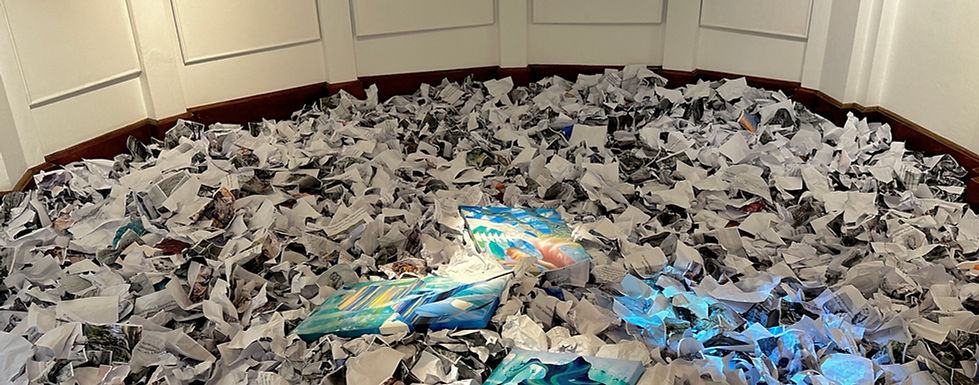
Oceanografías Sensibles
2024
Sensitive Oceanographies arises from my current context in the Cóbano area of Puntarenas, where nature unfolds its majesty on beaches like Montezuma, Malpaís, Santa Teresa, Playa Hermosa, and Manzanillo. These coasts, increasingly visited by tourists, become stages for encounters and tensions between different realities: natural beauty, pollution, and the transformations resulting from human activity. In this project, I explore the interactions between bodies of water, their relationship with technology in the face of contemporary challenges, and the possibilities of creating new connections.
I start from the premise that the ocean is a non-human intelligence: a vast and complex organism with its own language. Although this language is not fully comprehensible, we can observe it and analyze its mechanisms of resistance and adaptability. In this project, I compile records, develop methodologies, explore fictional scenarios, and conduct explorations that seek to decipher this language. The works include paintings that integrate abstractions of sounds, textures, tones, and elements of the ocean and the beach, such as salt, establishing a material and symbolic connection with the sea.
The texts and images on paper contain fragments of my research log: personal notes, quotes from poets, artists, and scientists, and poems generated with artificial intelligence. These poetic reflections address questions and reflections. Some of the texts and phrases on the sheets that make up the installation are:
- The flows of the sea generate complex patterns that suggest an underlying intelligence.
- When I am facing the sea and close my eyes, I feel its presence.
- The sea seems to communicate through crabs and other living beings, using their behavior as an extension of its own language.
- “Water has a skin formed by surface tension, and that tension is the result of the weak bond between the hydrogen atoms in each water molecule.” (Tristan Gooley, 2019).
The project is inspired by the Sapir-Whorf linguistic hypothesis, which posits that language defines our perception of the world. If immersing ourselves in a new language transforms our minds and emotions, what happens when we try to immerse ourselves in the language of a non-human intelligence, like the ocean?
Sensitive Oceanographies connects patterns and clues. What links the ocean to a stone, a crab, a piece of plastic, and my own existence? It is an invitation to imagine, to reinterpret, and to reflect on our connections with water, on what we leave behind and what we find in it. It is an invitation to imagine, to redefine and to reflect on our connections with water, on what we leave behind and what we find in it.
The installation is an invitation to experience a sensory journey that transforms over time. Each visitor discovers unique findings and connections: a phrase, a sound, an image that resonates with their own perception. More than a static exhibition, the work unfolds as a space for collective exploration, where questions remain open and the dialogue with the ocean becomes an act of imagination and discovery.
This project was part of the exhibition "A Language Imbued with Relationships and Care: Sensitive Oceanographies," presented in San José, Costa Rica, in 2024, as part of the "Inhabiting the Ocean" initiative and the preparatory activities for the United Nations Ocean Conference.
Karla Herencia.
A Language Imbued with Relationships and Care: Sensitive Oceanographies
This exhibition celebrates the complexity and importance of the ocean, its constant adaptation to tectonic forces, and its ongoing negotiation with a diverse spectrum of human and non-human beings to reimagine ways of coexisting in a context of profound ecological, economic, and social change.
The proposal is the result of a sensitive exploration undertaken by visual artist Karla Herencia on the Nicoya Peninsula, on Costa Rica's Pacific coast. This is a land of contrasts, bordered by both estuaries and mangroves, as well as a growing influx of tourists. The installation blends a wide variety of media: sounds, videos, sculptures, texts, paintings, found objects, artificial intelligence, photographs, and drawings. After establishing protocols, the artist's wandering has allowed her to collect traces and footprints that, as they accumulate, create layers, sounds, a language.
Sensitive Oceanographies is a space for contemplation and sensory connections that invites viewers to lean in, to analyze meticulously, and to allow themselves to be enveloped in the same way that Karla Herencia has perceived the challenges of the ocean, which she now attempts to decipher through its sounds, rhythms, and movements.
Much more than just a body of water, the ocean embodies constant encounters, discoveries, and metamorphoses, reconnecting the individual with sensations that are both primal and profound.
Curatorial support and exhibition curatorship by Laurent Le Bourhis · Ron Reyes Sevilla


